The Hidden Danger in Residential Gas Furnaces
During Antelope Valley winter cold snaps, night temperatures frequently plunge into the 20s and 30s. Your gas furnace operates under intense thermal expansion and contraction cycles. At the center of your heating system is the heat exchanger—a series of curved steel chambers designed to contain toxic combustion gases while transferring heat to your home's breathable air.
Critical Safety Warning
A cracked heat exchanger is an urgent life-safety hazard because it breaches the physical barrier between exhaust fumes and your home's air supply, allowing odorless, invisible carbon monoxide (CO) gas to circulate directly through your registers. If your carbon monoxide detector sounds or your furnace exhibits rollout switch trips, shut off the gas valve and furnace electrical switch immediately.
Why Do Heat Exchangers Crack in Desert Climates?
High desert furnaces experience severe thermal shock. In winter, attic ambient air can be 28°F when burner combustion ignites at over 1,000°F. The primary culprit behind premature heat exchanger cracking is restricted airflow. Dirty air filters or closed supply vents cause heat to back up inside the furnace plenum, overheating the aluminized or stainless steel until micro-fractures develop along crimped seams or tube bends.
Key Symptoms Palmdale Homeowners Can Observe
- Flame Behavior Changes When Blower Starts: When the indoor blower fan engages, increased static air pressure forces air through cracks into the burner chamber. If your burner flame wavers, flutters, or turns from crisp blue to yellow/orange when the fan turns on, a cracked heat exchanger is virtually certain.
- Soot Accumulation: Incomplete gas combustion produces black soot inside the furnace burner compartment or around the flue draft hood.
- Unpleasant Chemical or Metallic Odor: An acrid, formaldehyde-like smell emitting from supply registers indicates raw combustion byproducts leaking into the ductwork.
- Flame Rollout Switch Tripping: Safety switches located near the burners detect heat spilling backward instead of drawing into the flue pipe.
How AV Action Air Technicians Test for Cracks
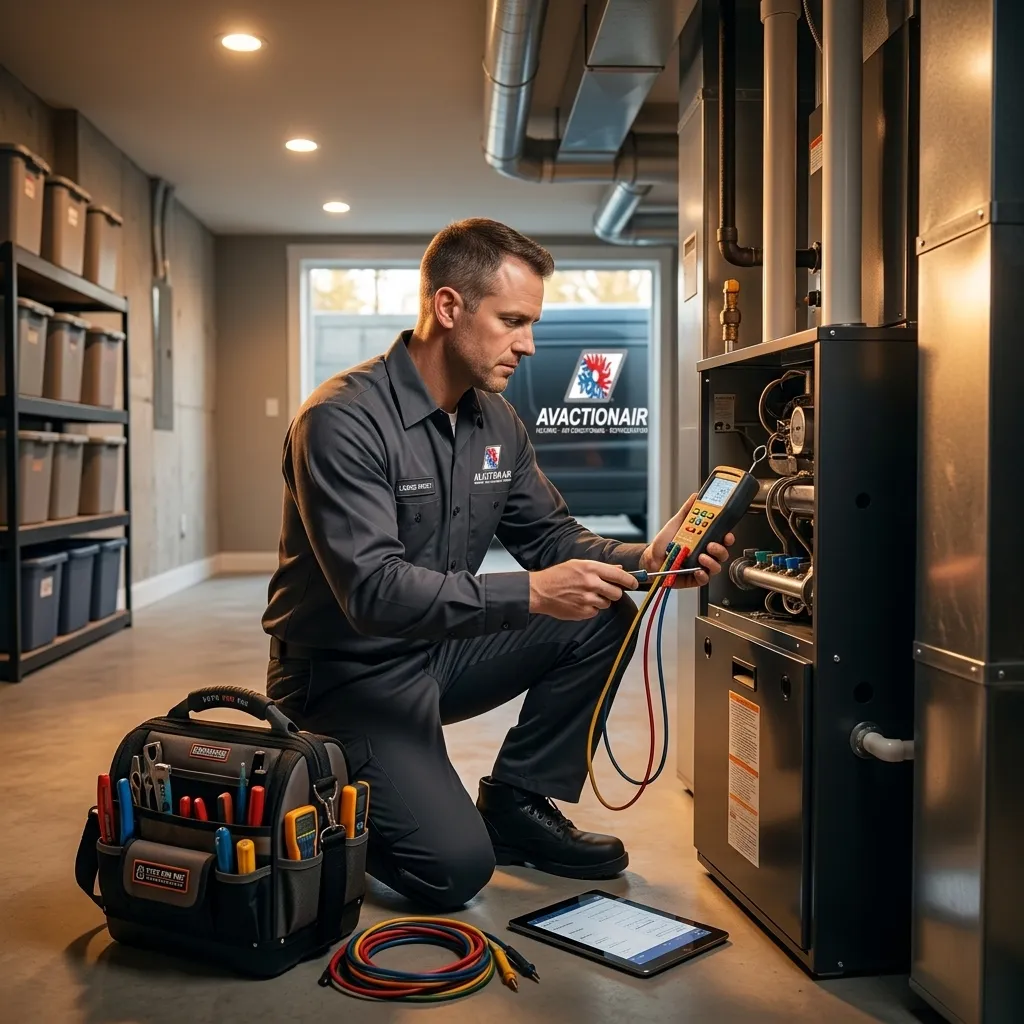
Visual inspection alone cannot reveal cracks hidden deep within clamshell folds. Our technicians use high-resolution flexible borescope cameras inserted through limit switch ports, electronic combustion analyzers measuring flue gas oxygen and CO parts per million (PPM), and static pressure differential testing to verify heat exchanger integrity with absolute certainty.
Under California CSLB regulations and national gas safety codes, a cracked heat exchanger cannot be welded or patched—it must be replaced or the furnace upgraded to ensure family safety.